
Why Laboratory Testing Is Central to Modern Medical Care
A medical laboratory is one of the most important parts of a modern health system, even though patients often do not see most of the work happening inside it. When a physician orders blood work, urine testing, tissue analysis, cultures, or other diagnostic studies, the laboratory helps turn a patient sample into usable clinical information. That information may support diagnosis, monitor a chronic condition, check medication safety, confirm whether further testing is needed, or help the care team make a faster decision.
Laboratory testing is not separate from patient care. It is part of the diagnostic process. A patient may come in with fatigue, fever, chest discomfort, abdominal pain, high blood pressure, abnormal imaging, medication side effects, or symptoms that are difficult to explain from the physical exam alone. In many of these situations, the physician needs objective data to understand what is happening inside the body. The laboratory helps provide that data.
The Centers for Disease Control and Prevention notes that clinical laboratory testing informs the majority of diagnoses, which creates an opportunity for laboratory professionals and healthcare providers to work together to reduce diagnostic error and improve diagnostic excellence. This does not mean every diagnosis depends only on a lab result. It means laboratory information often plays a major role when physicians combine symptoms, medical history, physical examination, imaging, and clinical judgment.
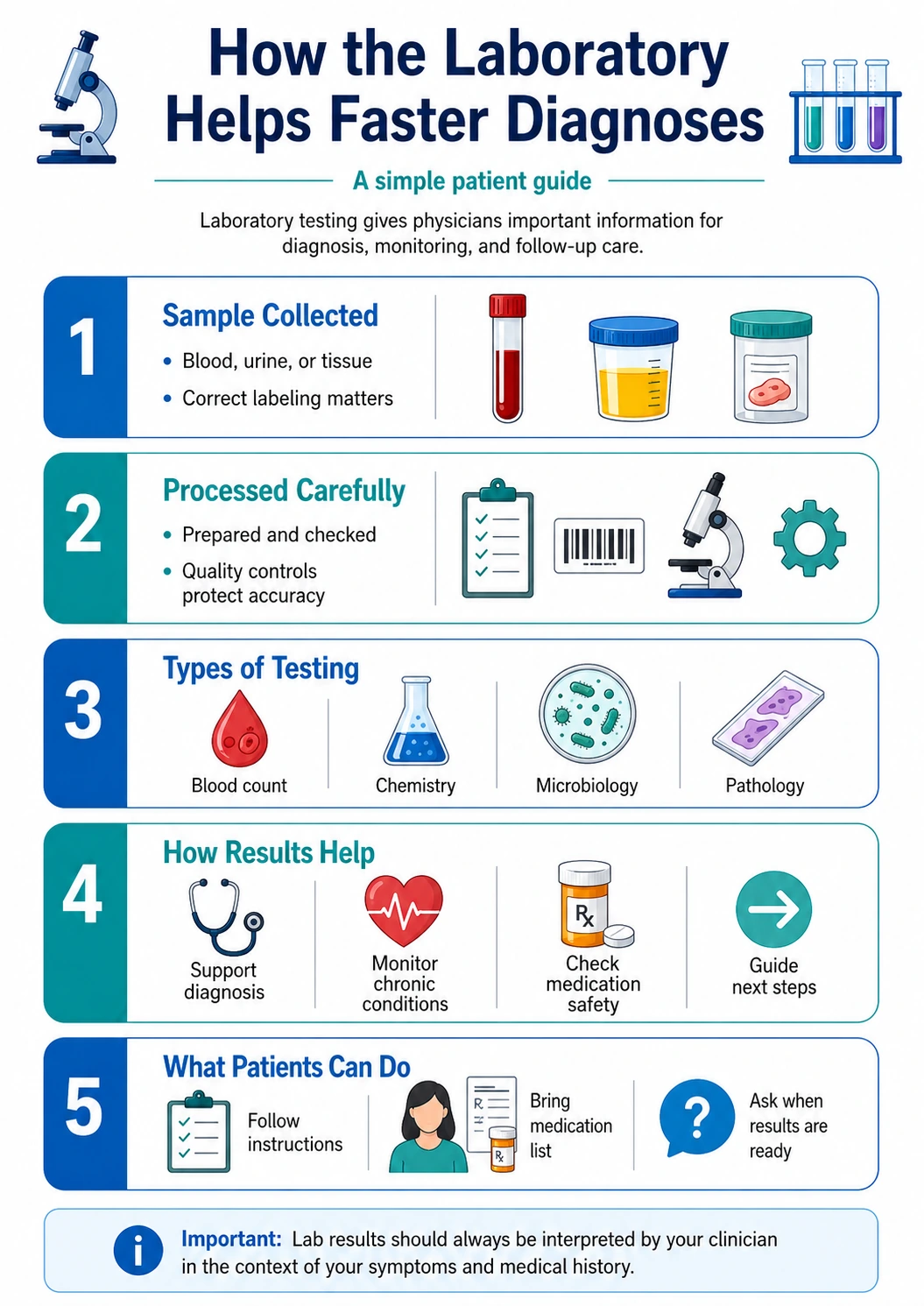
Laboratory results are most useful when they are accurate, timely, and interpreted in the context of the patient’s symptoms, history, medications, risk factors, and physical exam.
For patients, this distinction matters. A lab result is not simply “normal” or “abnormal” in isolation. The meaning depends on why the test was ordered, whether the sample was collected correctly, whether the patient followed preparation instructions, what medications they take, what symptoms are present, and whether previous results show a trend. A number that is harmless for one patient may require closer review in another.
Sweet water medical center explains that laboratory tests check a sample of blood, urine, or body tissue and that results may be affected by factors such as age, sex, race, what the patient ate or drank, medicines taken, and how well pre-test instructions were followed. This is why physicians often look at patterns, repeat testing when needed, and explain results within the full clinical situation.
Laboratory testing also supports preventive care. During a routine visit, a physician may order blood work to evaluate cholesterol, blood sugar, kidney function, liver function, anemia, thyroid function, medication safety, or other concerns based on the patient’s history. These tests may reveal changes before the patient feels symptoms. Patients who want to understand where lab work fits into prevention can review routine visits where lab work may be recommended.
In urgent settings, laboratory information can help physicians decide how quickly a patient needs treatment, imaging, observation, referral, or hospital-level care. For example, a patient with fever and weakness may need evaluation for infection, dehydration, inflammation, medication effects, or organ stress. A patient with chest symptoms may need a combination of clinical exam, electrocardiogram, blood tests, and imaging depending on the situation. The lab is one part of a larger decision-making process.
A diagnostic laboratory also plays a role in chronic disease management. Patients with diabetes, kidney disease, high blood pressure, thyroid disease, heart risk factors, anemia, autoimmune disease, or long-term medication use may need periodic testing to monitor stability and safety. The value is not only in one result, but in comparing results over time.
What Happens After Your Sample Is Collected
For most patients, the laboratory process begins with a simple moment: a blood draw, urine sample, swab, or tissue specimen. After that, a structured workflow begins. Each step matters because the final result depends not only on the machine or test method, but also on correct identification, collection, handling, transport, processing, analysis, review, and reporting.
The first priority is patient and sample identification. The care team must make sure the sample is connected to the correct patient and the correct order. This usually involves labels, barcodes, patient identifiers, and verification steps. A mislabeled sample can create serious risk, which is why laboratories use standardized procedures to reduce errors before testing begins.
Collection technique also matters. Some tests require a specific tube, timing, temperature, handling method, or collection container. A blood sample may need to be drawn in a certain order. A urine sample may need a clean-catch method. A swab may need to be taken from the correct site. A tissue sample may need special preservation. If collection is not done correctly, the result may be delayed, rejected, or less reliable.
After collection, the sample may be transported within the medical center or sent to another specialized laboratory, depending on the test. Some tests can be performed quickly on-site. Others require more complex equipment, trained specialists, culture time, molecular methods, pathology review, or reference laboratory processing. This is why turnaround time can vary widely.
Once the sample reaches the laboratory, it may be logged, sorted, prepared, centrifuged, separated, stained, cultured, placed on an analyzer, examined under a microscope, or processed using another method. The exact steps depend on the test category. A complete blood count, chemistry panel, urine culture, pathology specimen, and molecular test all follow different workflows.
Quality control is built into the process. Laboratories use controls, calibration, maintenance, procedure checks, trained personnel, and result review to support accuracy. The CDC describes laboratory test standardization as a process that helps certain tests give the same result for a given biomarker regardless of which laboratory test is used to measure it. For patients, this means accuracy is not accidental; it is supported by systems.
When results are ready, they are reported to the ordering clinician. Some results may be automatically released into a patient portal, while others require physician review, interpretation, or direct communication. A result that appears abnormal to a patient may not always represent an emergency. A result that appears only mildly abnormal may still matter in the wrong context. This is why patients should discuss important results with the care team rather than interpret them alone.
Basic Steps From Sample Collection to Result
The exact workflow depends on the type of test, but the process often includes several core steps:
- The patient sample is collected using the required method
- The sample is labeled and matched to the correct order
- The specimen is transported or routed to the correct testing area
- The laboratory prepares the sample for analysis
- Testing is performed using the appropriate method
- Quality checks support accuracy and reliability
- Results are reviewed and released to the ordering clinician
- The physician interprets the result in clinical context
This workflow explains why a laboratory result is not just a number printed on a report. It is the outcome of a coordinated process involving patients, nurses, phlebotomists, laboratory technologists, pathologists, physicians, information systems, and quality procedures. When the process works well, the physician receives information that can guide safer and faster care.
Common Test Categories and How They Support Care
Different tests answer different clinical questions. A physician does not order every available test for every patient because unnecessary testing can create confusion, false positives, cost, anxiety, and follow-up procedures that may not help. The purpose of testing is to answer a specific question or monitor a defined risk.
| Test category | What it may help evaluate | How physicians may use the information |
|---|---|---|
| Blood count | Red cells, white cells and platelets | May support evaluation of anemia, infection, inflammation or bleeding risk |
| Chemistry panel | Electrolytes, kidney markers, liver-related markers and glucose | May help assess organ function, dehydration, medication effects or metabolic risk |
| Lipid testing | Cholesterol-related markers | May support cardiovascular risk assessment and prevention planning |
| Urine testing | Kidney-related signs, infection clues or metabolic findings | May help evaluate urinary symptoms, kidney concerns or systemic disease patterns |
| Microbiology testing | Possible infectious organisms | May help guide treatment decisions when infection is suspected |
| Pathology review | Cells, tissue structure or biopsy findings | May help clarify abnormal imaging, screening findings or suspicious lesions |
| Hormone-related testing | Selected endocrine or reproductive markers | May support evaluation of symptoms such as fatigue, cycle changes or thyroid concerns |
| Medication level testing | Amount of certain medicines in the blood | May help determine whether a dose is safe and effective for selected drugs |
This is why lab testing services should be viewed as part of medical decision-making, not as a separate consumer checklist. The same test can have different meaning depending on the patient. A blood count ordered for fatigue is not interpreted the same way as a blood count ordered during infection treatment, cancer follow-up, surgery preparation, or medication monitoring.
Patients should ask why a test is being ordered, what the physician is looking for, how the result may change the plan, and whether any preparation is needed. These questions can reduce anxiety and help patients understand the value of the result.
Why Accuracy Matters More Than Speed Alone
Patients often want results as quickly as possible, especially when they are worried about symptoms, waiting for a diagnosis, or trying to understand whether treatment is working. Speed is important, but it cannot be separated from accuracy. A fast result that is unreliable can mislead the physician, create unnecessary anxiety, delay the correct diagnosis, or lead to an unsafe treatment decision.
Accuracy begins before the sample reaches the analyzer. The patient must be correctly identified. The right sample must be collected in the right container. Preparation instructions must be followed when required. The specimen must be transported and stored properly. If any of these steps are incorrect, the result may be delayed, rejected, repeated, or interpreted with caution.
The laboratory itself uses quality systems to reduce error. These may include instrument calibration, control materials, maintenance schedules, standardized procedures, staff training, result verification, and review of unexpected findings. In some cases, a result may be repeated or confirmed before it is released. This extra step may take more time, but it can protect the patient from a misleading report.
Some results are delayed because the test itself requires time. A culture may need time for organisms to grow. A pathology specimen may need processing, staining, microscopic examination, and specialist review. A specialized send-out test may need transport to another laboratory. Molecular or genetic testing may involve more complex workflows. A longer turnaround time does not automatically mean something is wrong; it may reflect the nature of the test.
Accuracy also depends on clinical context. For example, a lab value slightly outside the reference range may be expected for a patient taking a certain medication or recovering from illness. Another value inside the reference range may still need attention if it has changed significantly from the patient’s previous baseline. The physician interprets the result alongside symptoms, exam findings, medication use, imaging, and prior results.
A reliable laboratory result is not only a number; it is the product of correct collection, careful processing, quality control, professional review, and clinical interpretation.
Patients should ask when a result is expected and how they will receive it. They should also ask whether a result needs urgent action or routine discussion. Patient portals can make results visible quickly, but fast access does not always mean the patient should interpret complex findings alone. Some results need a physician’s explanation to avoid unnecessary fear or false reassurance.
How Faster Results Can Change the Patient’s Next Step
When results are available at the right time, the care team can move from uncertainty to a more specific next step. This does not mean every test gives an immediate answer. It means that timely information can help the physician decide whether to treat, observe, order imaging, repeat testing, refer to a specialist, adjust medication, or reassure the patient when serious causes appear less likely.
In acute care, timely laboratory results may help determine whether a patient needs emergency care, urgent care, observation, or outpatient follow-up. A patient with fever, weakness, dehydration, chest symptoms, abdominal pain, dizziness, or worsening chronic disease may need a combination of vital signs, physical exam, laboratory data, and sometimes imaging before the safest setting is clear.
For example, a patient with signs of infection may need testing that helps the physician decide whether the illness appears mild, whether there are signs of organ stress, whether antibiotics are appropriate, or whether emergency evaluation is needed. A patient with abdominal pain may need laboratory information that supports or reduces concern for inflammation, liver or pancreas involvement, kidney issues, urinary infection, or dehydration. The lab result does not diagnose every cause by itself, but it helps narrow the next decision.
In chronic disease care, faster results can help prevent delays in medication adjustment. A physician may need kidney function, potassium, liver markers, glucose, cholesterol, thyroid function, or blood counts before safely changing a medication. If the result is delayed, the treatment decision may also be delayed. When the result is timely, the patient can receive a clearer plan sooner.
Laboratory results can also guide imaging decisions. A physician may order imaging after an abnormal lab result, persistent symptoms, or a physical exam finding. In other cases, normal or stable lab results may reduce the need for immediate imaging. The decision depends on the full clinical picture, not on the laboratory report alone.
Same-day care decisions can also depend on testing. Some patients begin in an office or urgent care setting but are sent to the emergency department when results, symptoms, or vital signs suggest a higher level of risk. Other patients can avoid unnecessary escalation when the evaluation shows they are stable for outpatient follow-up. A practical overview of deciding between urgent and emergency care can help patients understand why the care setting may change.
Timely results can reduce uncertainty, but they do not remove the need for communication. Patients should know who will contact them, which results require action, whether normal results will be communicated, and what to do if symptoms worsen while waiting. A clear process helps prevent missed follow-up.
The Laboratory’s Role in Chronic Disease Management
Many chronic conditions cannot be managed safely by symptoms alone. A patient may feel well while blood sugar rises, kidney function changes, cholesterol remains high, thyroid levels shift, anemia develops, or medication side effects appear. Laboratory monitoring gives physicians objective information that can support safer long-term care.
High blood pressure is one example. Blood pressure readings show vascular strain, but lab tests may help evaluate related risks, kidney function, electrolytes, diabetes risk, and medication safety. A patient with hypertension may need periodic testing depending on the medications used, other conditions, and treatment goals. Patients who are concerned about readings or symptoms can review medical attention for high blood pressure concerns.
Diabetes and prediabetes also depend heavily on laboratory monitoring. Blood glucose markers, kidney function, urine findings, cholesterol, and other tests may help physicians understand whether the condition is stable and whether complications are developing. Symptoms alone are not enough because early changes may be silent.
Kidney disease often requires careful tracking. The kidneys may compensate for a long time before symptoms become obvious. Laboratory markers can help physicians monitor function, medication safety, hydration status, electrolyte balance, and the effects of blood pressure or diabetes. Changes over time may be more important than one isolated result.
Thyroid disease is another example. Fatigue, weight change, palpitations, cold intolerance, anxiety, constipation, hair changes, or menstrual changes may suggest a thyroid-related issue, but symptoms overlap with many other conditions. Testing helps the physician evaluate whether thyroid function is contributing to the patient’s symptoms and whether treatment is appropriately adjusted.
Medication monitoring is also a major laboratory function. Some drugs can affect kidney function, liver function, electrolytes, blood counts, or therapeutic levels. Patients taking long-term medications should ask whether monitoring is needed and how often results should be reviewed. Stopping medication without guidance can be risky, but so can continuing a medication without appropriate follow-up.
Heart disease prevention often relies on laboratory information as well. Cholesterol, blood sugar, kidney function, inflammation markers in selected cases, and medication safety data may help a physician personalize prevention. Patients looking at broader prevention can review heart disease prevention habits.
Why Some Results Take Longer Than Others
Patients may feel anxious when one result returns quickly and another takes several days. Different turnaround times usually reflect different testing methods. Some tests are automated and can be completed relatively quickly. Others require growth time, specialist interpretation, complex preparation, or referral to a specialized laboratory.
| Reason for delay | Why it may happen | What patients should know |
|---|---|---|
| Special handling required | The sample may need a specific temperature, container or preparation step | Correct handling protects result reliability |
| Culture time | Some organisms need time to grow before identification is possible | A delay does not automatically mean the result is serious |
| Microscopic review | A trained professional may need to examine cells or tissue | Specialist interpretation can take longer than automated testing |
| Confirmatory testing | An unexpected or important result may need verification | Repeating or confirming a result can improve confidence |
| Reference laboratory processing | Some tests are sent to specialized external laboratories | Transport and specialized workflow can extend turnaround time |
| Physician review needed | The result may require interpretation before communication | Patients should ask how and when they will be contacted |
Patients should not assume that faster results are more important or that slower results are more alarming. The clinical meaning depends on the test, the reason it was ordered, the patient’s symptoms, and whether urgent findings require immediate action. If symptoms worsen while waiting, the patient should contact the care team rather than wait silently for the portal to update.
How Lab Results Support Cancer Screening and Follow-Up
Laboratory work can support cancer screening and follow-up in several ways, but it is important to understand its limits. Most blood tests do not “screen for all cancers,” and a normal result does not rule out every cancer. Instead, laboratory information helps physicians evaluate specific findings, process tissue or cell samples, monitor certain conditions, and clarify what should happen after an abnormal screening result.
For example, after a biopsy, pathology review may determine whether a tissue sample is benign, precancerous, malignant, inflammatory, infectious, or unclear. This type of review can influence whether the patient needs monitoring, additional imaging, specialist referral, treatment discussion, or repeat sampling. The patient may only see the final report, but the process behind that report can be central to the next medical decision.
Laboratory testing may also be used when a patient has symptoms that require diagnostic evaluation. Unexplained anemia, abnormal liver markers, blood in urine, abnormal blood counts, persistent inflammation, or certain abnormal chemistry results may lead a physician to recommend further evaluation. These findings do not automatically mean cancer is present, but they can help guide the next step.
Screening programs often involve several departments. A patient may begin with a routine visit, complete a screening test, receive an abnormal result, undergo imaging, and then need tissue or laboratory review. Clear coordination between primary care, imaging, the laboratory, specialists, and the patient reduces delays and helps prevent results from being misunderstood or lost in follow-up.
Patients reviewing screening options can learn more from cancer screening recommendations by age. If an abnormal screening result leads to additional testing, the laboratory may become part of the process that helps the physician move from uncertainty to a more specific diagnosis or follow-up plan.
Patients should ask what each result means and what follow-up is required. An abnormal result may require urgent action, routine follow-up, repeat testing, imaging, biopsy, or specialist review. A normal result may still require continued screening at the recommended interval. The most important point is not the isolated result; it is whether the next step is clear.
Meet the People Behind the Results
Patients often interact with a physician, nurse, medical assistant, or phlebotomist, but the laboratory process involves many professionals who may never meet the patient directly. Their work still affects the patient’s care. Behind each report may be trained laboratory technologists, technicians, pathologists, specimen processors, phlebotomy staff, quality specialists, couriers, information system teams, and physicians who interpret the result in context.
Phlebotomists and collection staff are often the first laboratory-related professionals a patient meets. Their role is not only drawing blood or collecting a specimen. They help verify identity, follow collection procedures, label samples correctly, and make the experience as safe and efficient as possible. A calm, careful collection process can reduce errors and improve patient confidence.
Laboratory technologists and technicians perform much of the analytical work. They operate instruments, prepare samples, run tests, review quality checks, identify technical problems, and make sure results meet procedural standards before release. Their work requires precision because small errors in handling or analysis can affect clinical interpretation.
Pathologists may review tissue, cells, blood smears, or complex findings under a microscope. In cancer-related evaluation, pathology can be especially important because the pathologist’s interpretation may help determine whether a finding is benign, suspicious, malignant, inflammatory, infectious, or requires additional testing. This work often happens outside the patient’s view but can be essential to the physician’s plan.
Laboratory leadership and quality teams help maintain procedures, training, compliance, equipment function, and reporting standards. Their role is to make sure the system is reliable, not just that one individual test is completed. This is one reason a strong laboratory supports trust in the entire medical center.
The laboratory also communicates with clinicians. If a result is critical, unexpected, delayed, rejected, or needs clarification, the laboratory may contact the care team. Physicians may also call the laboratory to ask about test selection, interpretation, specimen quality, or whether additional testing is appropriate. This collaboration supports safer decisions.
Patients who want to understand how different professionals work together during care can review the care team involved during a hospital stay. The same idea applies to laboratory work: modern diagnosis is rarely the work of one person alone.
How Patients Can Help the Laboratory Process
Patients are not responsible for running laboratory tests, but they can help the process by following instructions and giving accurate information. A well-prepared patient can reduce delays, repeat collections, and confusion about results.
Preparation depends on the test. Some tests require fasting. Others require a specific collection time, medication timing, clean-catch urine method, avoidance of certain activities, or completion of a sample at home. If instructions are unclear, patients should ask before the appointment rather than guess.
Patients should also tell the care team about medications, supplements, recent illness, pregnancy status when relevant, dehydration, recent exercise, alcohol use, or whether instructions were not followed. This information may affect interpretation. The goal is not to blame the patient, but to help the physician understand whether a result is reliable and meaningful.
Specimen labeling and identification should be taken seriously. Patients may be asked to confirm their name, date of birth, or other identifiers more than once. This can feel repetitive, but it is an important safety step. Correct identity protects the patient from wrong results and wrong medical decisions.
Simple Ways to Support Reliable Results
Patients can improve the quality of the testing process by following a few practical steps:
- Follow fasting or preparation instructions exactly when they are provided
- Bring a complete medication and supplement list
- Ask whether medications should be taken before the test
- Confirm how and when results will be communicated
- Tell the care team if preparation instructions were not followed
- Keep copies of important previous results when possible
- Contact the clinic if symptoms worsen while waiting
- Ask what follow-up is needed after abnormal or unclear findings
Patients should also avoid comparing results online without context. Reference ranges can vary by laboratory, method, age, sex, pregnancy status, and clinical situation. A result slightly outside the range may not always be dangerous, while a result inside the range may still require attention if it has changed significantly from the patient’s baseline. The ordering clinician is responsible for connecting the result to the patient’s health.
Why a Strong Laboratory Builds Trust in the Medical Center
A medical center’s laboratory is more than a technical department. It is part of the patient experience, even when patients never see the analyzers, quality checks, specimen processors, or professionals reviewing results. When the laboratory is well organized, physicians can make decisions with greater confidence, patients receive clearer next steps, and follow-up care becomes more coordinated.
Trust grows when patients understand the process. A result does not appear instantly because someone presses a button. It moves through collection, identification, processing, analysis, quality review, reporting, and interpretation. Each step exists to protect the reliability of the final information.
A strong laboratory also supports continuity. The same patient may need testing during a routine check-up, urgent visit, chronic disease follow-up, cancer screening, medication review, surgery preparation, or hospital stay. Having laboratory services integrated with the care team can reduce fragmentation and help physicians compare results over time.
Communication is also central to trust. Patients should know how results will be delivered, who will explain them, what needs urgent follow-up, and what can wait for a scheduled visit. A laboratory report becomes more valuable when the patient understands what action, if any, should follow.
For physicians, reliable laboratory support can improve speed without sacrificing accuracy. For patients, it can reduce uncertainty and help move the care plan forward. For the medical center, it shows that infrastructure, not only individual appointments, shapes the quality of care.
The phrase clinical lab testing may sound technical, but for patients it often means something very practical: a clearer answer, a safer medication decision, a faster follow-up step, or confirmation that the current plan is working. That practical value is why the laboratory deserves attention in any discussion of modern diagnosis.
Medical Disclaimer
This article is for educational purposes only and does not replace professional medical advice, diagnosis, or treatment. Laboratory results should be interpreted by a qualified clinician in the context of symptoms, medical history, medications, examination findings, and follow-up needs.
Author
By Dr. Cody R. Christensen, M.D. He practices at Sweetwater Medical Center, where he integrates pharmacologic treatment with lifestyle medicine and psychotherapy to support lasting patient wellness.
Medically Reviewed: by Clinical Pharmacy Board
Last Updated: 08.06.2026
FAQ
How long do lab results usually take?
Turnaround time depends on the test type, sample handling, equipment, specialist review, and whether the test is performed on-site or sent to another laboratory. Some results may return quickly, while cultures, pathology, molecular tests, or specialized studies may take longer.
Why do some tests take longer than others?
Some tests require culture growth, microscopic review, confirmatory testing, special handling, or external laboratory processing. A longer wait does not automatically mean the result is more serious.
Can I interpret my results myself?
You can review your results, but interpretation should come from a qualified clinician who understands why the test was ordered. Symptoms, medications, previous results, age, preparation, and medical history can all change the meaning of a result.
What happens if a result is abnormal?
An abnormal result may require repeat testing, monitoring, medication adjustment, imaging, referral, or no urgent action depending on the context. Patients should ask what the result means and what the next step should be.
Why might a doctor repeat a test?
A repeat test may confirm an unexpected result, track a trend, check whether treatment is working, or make sure the sample was reliable. Repeating a test is often a safety step, not necessarily a sign that something is wrong.