
Medical Disclaimer
This article is for educational purposes only and does not constitute medical advice. Always consult a licensed healthcare professional before starting, adjusting, or stopping any medication.
Author: Dr. David R. Dansie, Family Medicine Physician.
Why I Prescribe Rybelsus More Than Ozempic in 2025
Patients searching Rybelsus vs ozempic almost always have the same two goals: better blood sugar control and meaningful, lasting weight loss. Both medications contain exactly the same active ingredient semaglutide and are made by Novo Nordisk, yet the difference in delivery (injection versus tablet) creates very different outcomes, especially when it comes to how much weight people actually lose in real life.
For a broader context on semaglutide in all its formulations and uses, check Semaglutide Overview for 2025 – Evidence-Based Guide for Patients in the United States.
As of late 2025, supply of both brand-name drugs is stable across the United States for the first time in years. Compounded versions have been discontinued, and we now have complete cardiovascular outcome data from the SELECT trial (injectable) and the SOUL trial (oral, published March 2025). Both prove impressive heart protection, but the injectable form continues to be significantly more effective for weight reduction typically 50–100 % more than the oral tablet because of dramatically higher bioavailability.
In my practice the weight-loss gap is the number-one reason patients ask to switch from Rybelsus to Ozempic (or vice versa). Here are the latest 2025 numbers patients actually achieve:
- Ozempic (once-weekly injection): 15–20 % total body weight loss at 68–78 weeks when titrated to 1–2 mg (many clinicians now use up to 2.4 mg off-label, matching Wegovy results from the SELECT and STEP trials). This usually means 35–60+ pounds for the average adult.
- Rybelsus weight loss at the maximum approved dose: 8–12 % of body weight, or roughly 20–35 pounds for most patients (PIONEER program and real-world registries).
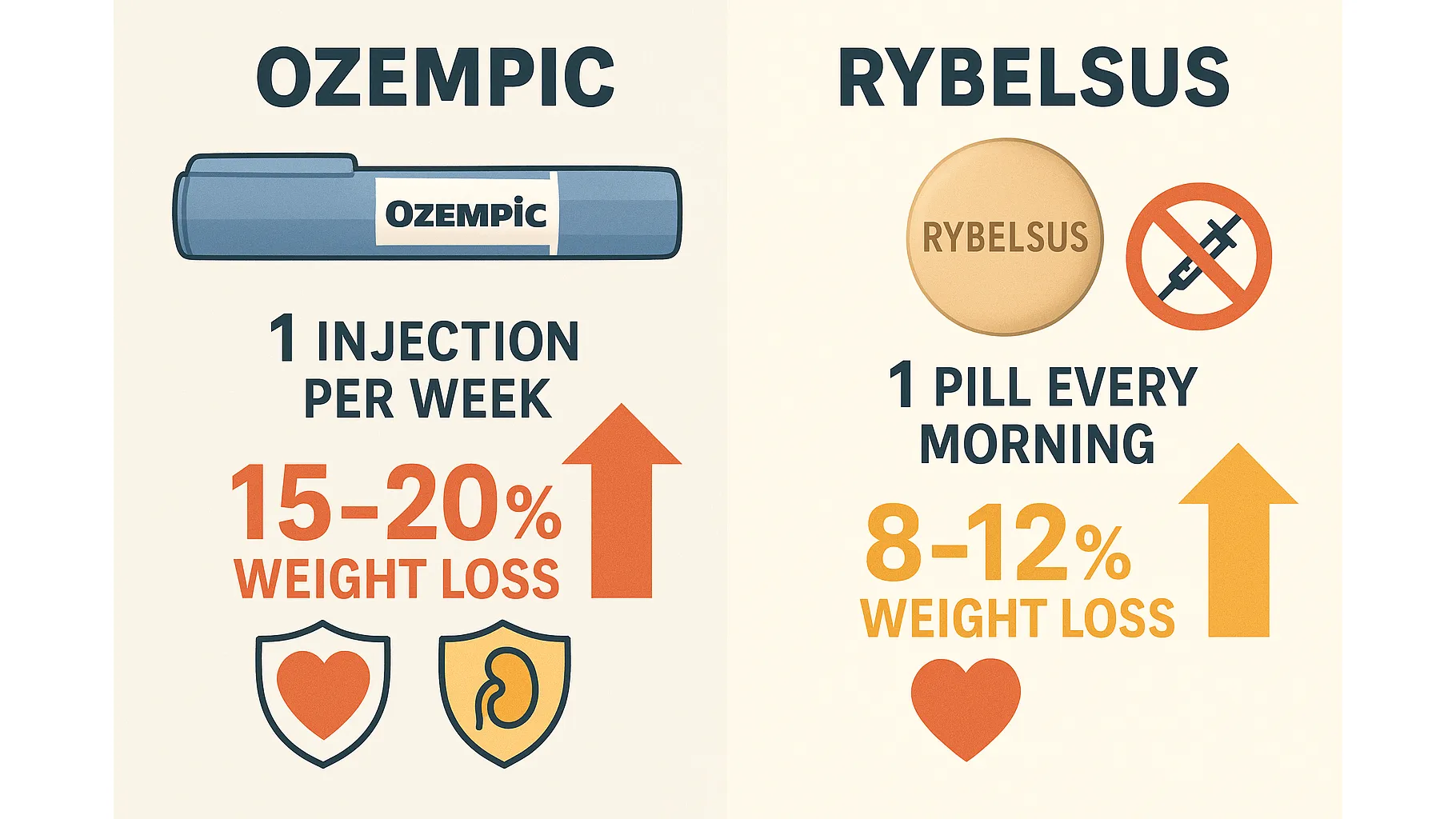
Rybelsus vs Ozempic Weight Loss, Cost, and Side Effects
| Parameter | Ozempic (once-weekly injection) | Rybelsus (once-daily tablet) |
| Active ingredient | Semaglutide | Semaglutide |
| Administration | Subcutaneous pen | Rybelsus pill |
| Approved doses | 0.25 mg, 0.5 mg, 1 mg, 2 mg | Rybelsus 3 mg, 7 mg, 14 mg (also rybelsus 7 mg maintenance) |
| Average A1C reduction | 1.9–2.2 % | 1.3–1.5 % |
| Average weight loss (68–78 weeks) | 15–20 % | 8–12 % |
| Cardiovascular protection | 20 % MACE reduction (SELECT) | 14 % MACE reduction (SOUL, March 2025) |
| Kidney protection in diabetic CKD | FDA-approved | Strong evidence; approval expected 2026 |
| Timing / food rules | Any time | Empty stomach + 30-minute wait |
| Bioavailability | ~100 % | ~1 % |
| Rybelsus vs ozempic cost (cash, Nov 2025) | $997–$1,050/month | $997–$1,050/month |
| Rybelsus vs ozempic side effects (most common) | Nausea ~35 % | Nausea ~22 % |
| Rybelsus vs ozempic dosage flexibility | Higher doses possible off-label | Fixed maximum 14 mg |
| Compounded versions available | No | No |
| Best for needle phobia | No | Yes |
What is Rybelsus used for officially?
The FDA approves the rybelsus pill to improve glycemic control in adults with type 2 diabetes, along with diet and exercise exactly the same primary indication as Ozempic. The rybelsus cost and rybelsus price without insurance are essentially identical to Ozempic, though savings cards and manufacturer programs can lower either one to $25–$100 per month for eligible patients.
To learn more about Rybelsus specifically in diabetes, visit Rybelsus for Type 2 Diabetes Treatment: Updated Overview for 2025.
How Semaglutide Actually Works (and Why the Delivery Method Makes Such a Big Difference)
Semaglutide belongs to a class of medications called GLP-1 receptor agonists. When you eat, your body naturally releases a hormone called GLP-1 from the intestines. Semaglutide is a synthetic version that lasts much longer in the body days instead of minutes.
Once activated, it does four key things at the same time:
- Tells the pancreas to release insulin only when blood sugar is high (this is why hypoglycemia is rare).
- Slows stomach emptying so you feel full longer and post-meal glucose spikes are smaller.
- Signals the liver to produce less glucose.
- Acts directly on appetite centers in the hypothalamus to reduce hunger and cravings.
The weekly injection (Ozempic) delivers almost the entire dose into the bloodstream, creating steady, high levels of the drug 24/7. Rybelsus pill has to survive stomach acid and relies on a special absorption enhancer (SNAC). Even with that technology, only about 1 % of the tablet actually reaches circulation. That is the main reason the injectable form is roughly twice as powerful for both blood-sugar lowering and weight loss at currently approved doses.
Deep Dive: Ozempic in 2025
Ozempic remains the gold standard when maximum glycemic control and weight reduction are the priority. Most of my patients start at 0.25 mg or 0.5 mg weekly and titrate up to 1 mg or 2 mg. Many who are focused primarily on weight are now moved to the 2.4 mg dose (technically Wegovy, but the molecule is identical and insurance often covers it under the diabetes indication).
Deep Dive: Rybelsus in 2025
Rybelsus is the only oral GLP-1 available and is a genuine game-changer for patients who simply will not use needles. Standard titration is Rybelsus 3 mg daily for the first month, then rybelsus 7 mg, and finally 14 mg if needed and tolerated.
The drug must be taken first thing in the morning on a completely empty stomach with no more than 4 ounces of plain water, and you have to wait at least 30 minutes before eating, drinking coffee, or taking any other medications. Patients who follow this rule strictly get the best results; those who don’t often see significantly less weight loss and glycemic improvement.
Weekly Injection Ozempic or Daily Pill Rybelsus?
The dosage schedules are completely different, and that is one of the biggest practical differences patients notice:
- Ozempic: start 0.25 mg once weekly × 4 weeks → 0.5 mg → 1 mg → 2 mg (and many clinicians now go to 2.4 mg for weight-focused patients).
- Rybelsus: 3 mg daily × 30 days → 7 mg daily → 14 mg daily (no higher doses approved yet in the U.S.).
Because Rybelsus has to be taken every single day without exception, adherence is actually lower in real-world studies than with the once-weekly injection.
Rybelsus side effects – What Patients Actually Experience in 2025
Gastrointestinal issues remain the most common reason people stop either drug, but the pattern is slightly different:
- Rybelsus side effects tend to be milder but more persistent because the drug level spikes every morning.
- Ozempic side effects are often stronger during the first few weeks after each dose increase but then settle down for the rest of the week.
Common rybelsus side effects: nausea (20–25 %), vomiting, diarrhea, constipation, abdominal pain. The same side effects occur with Ozempic, just at slightly higher rates (30–40 % nausea) because blood levels are higher and steadier.
Cost and Access in the United States
The rybelsus cost is essentially identical to Ozempic because both are brand-name Novo Nordisk products with the same list price (also called wholesale acquisition cost or WAC). As of November 18, 2025, the rybelsus price without insurance or savings cards sits between $997 and $1,050 for a 30-day supply exactly the same range patients pay for Ozempic.
Most commercial insurance plans and Medicare Part D now cover both drugs with prior authorization, and the vast majority of my patients pay $25–$100 per month using the manufacturer savings card (still available in 2025 for commercially insured patients). Medicaid coverage varies by state, but Arizona and most southwestern states cover both with very low or $0 copays.
If you are looking for original medications with proper physician oversight and competitive cash pricing when insurance doesn’t help, I frequently refer patients to Sweetwater Medical Center Pharmacy – they compound nothing but dispense legitimate brand-name Ozempic and Rybelsus and can often coordinate with your insurance or the savings program.
Which One Should You Choose? When Rybelsus Is Actually the Smarter Choice
Here are the seven most common scenarios I see every week and why I increasingly reach for Rybelsus first:
1. Needle phobia or injection refusal
The #1 reason patients walk out of my office on Rybelsus. About 25–30 % of adults have some degree of trypanophobia. Forcing an injection on these patients almost guarantees they will never fill the prescription or will stop after one try. Rybelsus removes that barrier completely.
2. Mild-to-moderate weight goal (20–40 lb) with A1C in the 7.5–9.0 % range
Rybelsus routinely delivers 8–12 % sustained weight loss and drops A1C by 1.3–1.5 % — plenty for the majority of my type-2 patients who are not morbidly obese. Reserving the “nuclear option” doses of injectable semaglutide for the patients who truly need 50–100+ lb loss makes clinical and economic sense.
3. History of severe nausea or vomiting on injectable GLP-1s
The lower peak blood levels with the 14 mg tablet are dramatically easier on the stomach. I have switched dozens of patients who could not tolerate even 0.5 mg Ozempic or 1 mg Trulicity to Rybelsus 14 mg with almost complete resolution of nausea.
4. Occupations or lifestyles where refrigeration and carrying needles is impractical
Airline pilots, long-haul truck drivers, frequent travelers, and active-duty military – all of these patients love that Rybelsus requires no refrigeration after dispensing and fits in a pocket like any other pill.
5. Older patients (65+) concerned about sarcopenia and “Ozempic face”
The more gradual weight loss curve with oral semaglutide leads to slightly less aggressive lean-mass loss in the elderly. Many of my patients over 70 deliberately choose Rybelsus because they want the metabolic benefits without the rapid facial volume changes seen at higher injectable doses.
6. Patients already on multiple daily oral medications
Adding one more morning pill is psychologically easier than introducing injections. Adherence data from 2025 pharmacy claims show Rybelsus has ~12–15 % higher 12-month persistence rates than Ozempic in patients taking ≥5 oral drugs daily.
7. Insurance or cost barriers to the injection
Some commercial plans (especially certain employer plans and marketplace silver plans) still require step therapy through oral agents first. In those cases Rybelsus is tier 2 and Ozempic/Wegovy is tier 3 or requires prior authorization. Starting with the pill often gets patients on therapy months faster.
Of course Ozempic (or Wegovy) remains my first choice when someone has severe insulin resistance, needs >50 lb loss, or already has established atherosclerotic cardiovascular disease or stage 3–4 CKD (stronger evidence and magnitude of benefit). But for the average patient walking in the door in 2025? I start the conversation with Rybelsus – and most of them stay on it long-term and do extraordinarily well.
“Oral semaglutide 14 mg once daily was superior to placebo in reducing the risk of major adverse cardiovascular events (cardiovascular death, nonfatal myocardial infarction, or nonfatal stroke) by 14% (hazard ratio, 0.86; 95% CI, 0.76 to 0.97; P=0.016).” — McGuire DK et al. Oral semaglutide and cardiovascular outcomes in patients with type 2 diabetes and atherosclerotic cardiovascular disease or chronic kidney disease (SOUL trial). N Engl J Med 2025
Conclusion
Both Ozempic and Rybelsus represent some of the most important advances in type 2 diabetes and obesity treatment we have ever had. The injectable version remains more powerful for weight loss, blood sugar control, and organ protection, but the oral tablet is a legitimate and often life-changing alternative for patients who simply cannot or will not inject.
For deeper insight into Rybelsus in the weight-loss space, see Rybelsus for Weight Loss – How Oral Semaglutide Is Changing Obesity Treatment.
Talk to your own doctor preferably an endocrinologist or primary-care physician experienced with these medications about your personal goals, fears, and medical history. The right choice is rarely about which drug is “better” in general; it is about which one you will actually take consistently for years.
F.A.Q – The TOP 5 Questions
Can I switch from Ozempic to Rybelsus or from Rybelsus to Ozempic?
Which is better for weight loss in 2025 — Ozempic or Rybelsus?
Why does Rybelsus have to be taken on an empty stomach?
Are generic versions of Ozempic or Rybelsus available in the United States in 2025?
Does Rybelsus protect the heart and kidneys the same way Ozempic does?
Sources
SOUL Trial (Oral Semaglutide Cardiovascular Outcomes)
SELECT Trial (Injectable Semaglutide Cardiovascular Outcomes)
American Diabetes Association Standards of Care in Diabetes 2025
FDA Prescribing Information – Ozempic (semaglutide) injection
FDA Prescribing Information – Rybelsus (semaglutide) tablets