
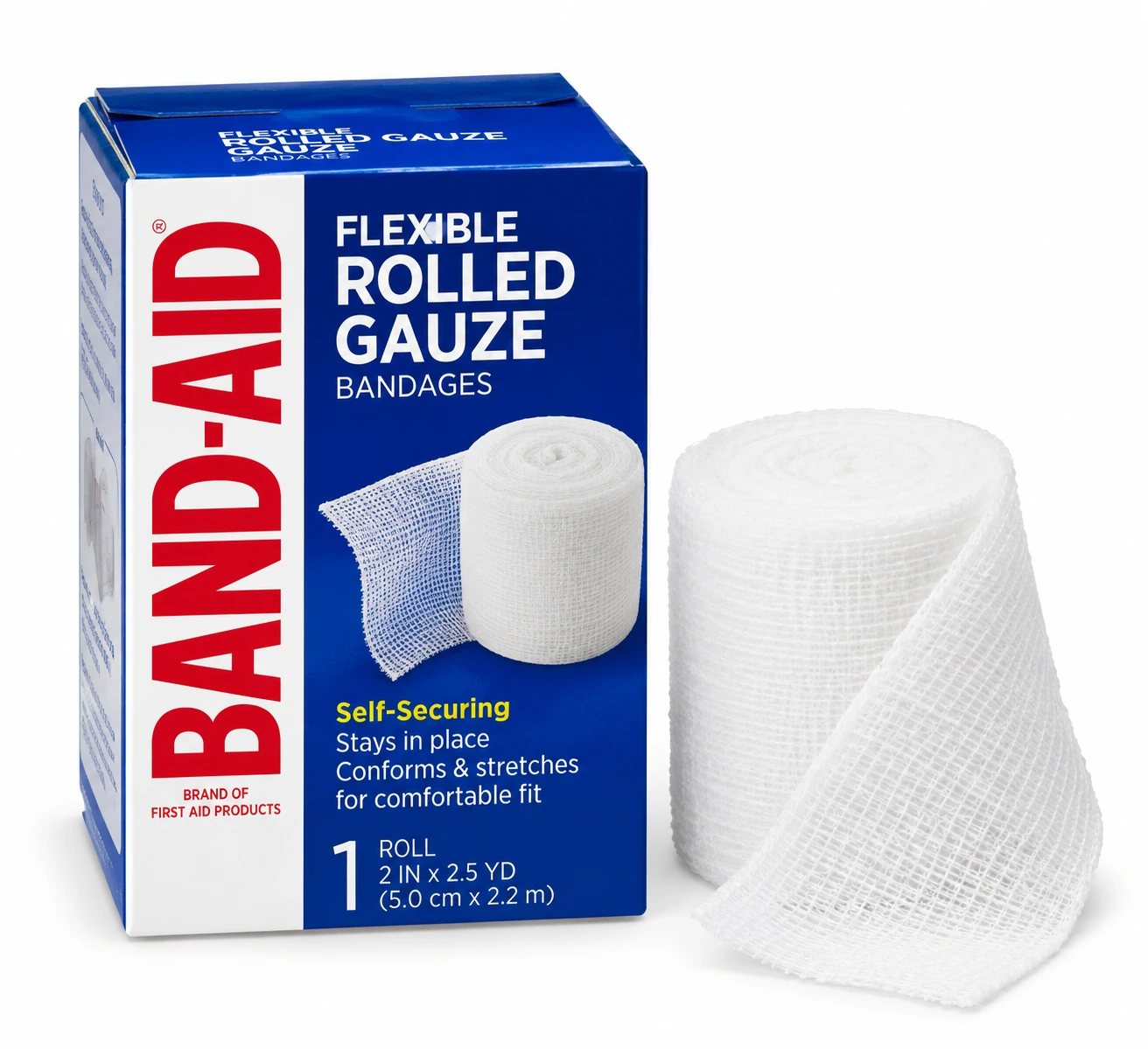
| Brand | Band-Aid |
| Product Type | Flexible sterile rolled gauze bandage |
| Design | KLING self-stick construction |
| Material Features | Stretchable, conforming and absorbent gauze |
| Primary Use | Securing wound dressings and covering minor injuries |
| Widths | 2, 3 and 4 inches |
| Roll Lengths | 2.1 or 2.5 yards, depending on the variant |
| Packaging | Single-roll and 5-count options |
| Sterility | Sterile unless the individual wrapper is opened or damaged |
| Natural Rubber Latex | Not made with natural rubber latex |
| Prescription Status | Over-the-counter first aid supply |
Flexible Gauze for Securing Wound Dressings
Band-Aid Flexible Rolled Gauze Bandages are sterile, stretchable gauze wraps designed to hold wound pads and dressings in place. The KLING self-stick construction allows the gauze to grip itself rather than the skin, often eliminating the need for separate medical tape.
The flexible roll conforms to fingers, arms, legs and joints without the rigidity of a standard adhesive strip. Its absorbent material can also be used as a primary dressing for minor cuts, scrapes and burns.
Pharmacy Availability
Band-Aid Flexible Rolled Gauze is a nonprescription first aid product. To locate an offline pharmacy, visit the Sweetwater Medical Center pharmacy finder for pharmacy locations and contact information.
Some wounds are difficult to cover with a conventional adhesive bandage. A dressing over an elbow may loosen when the arm bends, while a pad on the forearm or lower leg may need support around its edges. Rolled gauze addresses these problems by surrounding the dressing and holding it against the affected area. The material can be adjusted to the shape of the body without relying on adhesive contact with the skin.
How KLING Self-Stick Gauze Works
The defining feature of Band-Aid Flexible Rolled Gauze is its KLING construction. As the bandage is wrapped around the affected area, successive layers grip one another to hold the wrap in position. The material does not need to stick to the skin, making it useful when adhesive tape is inconvenient or the surrounding skin is sensitive.
Unlike an adhesive strip, a roll can cover the circumference of an arm, leg or finger and adapt to the contours of the area being dressed. It can also be used around a joint, where movement might otherwise shift a flat dressing.
Flexibility During Movement
The gauze stretches and conforms to the body, accommodating ordinary movement without requiring a rigid fit. This is particularly helpful around knees, elbows and other areas that bend. The wrap should still be applied with only enough tension to keep the dressing secure; stretching the material too tightly can create unnecessary pressure.
Absorbent Gauze Construction
Band-Aid Flexible Rolled Gauze is absorbent and may be used directly as a primary dressing for minor wounds. It is also suitable as a secondary wrap over a separate sterile gauze pad or non-stick dressing.
When a wound produces fluid, the underlying dressing should be selected according to the amount of drainage. For a sensitive wound surface, a dedicated non-adherent pad can provide a more suitable contact layer beneath the gauze roll.
Choosing the Right Roll Width and Length
Band-Aid offers several widths to accommodate different parts of the body. A narrower roll is generally easier to manage around a finger, hand or smaller limb, while wider gauze covers more surface area with each turn.
| Width | Roll Length | Package |
|---|---|---|
| 2 inches | 2.5 yards | 1 roll |
| 3 inches | 2.5 yards | 1 roll |
| 3 inches | 2.1 yards | 5 rolls |
| 4 inches | 2.5 yards | 1 roll |
| 4 inches | 2.5 yards | 5 rolls |
The 2-inch width is suited to smaller wrapping areas, while the 3-inch and 4-inch versions provide broader coverage for larger limbs and dressings. The appropriate size depends on the wound location, the underlying pad and the amount of material needed to hold it securely.
Using Rolled Gauze as a Dressing or Wrap
Rolled gauze serves two related purposes: it can cover a minor wound directly, or it can hold a separate dressing in place. The second method is useful when a specific absorbent or non-adherent wound pad has already been chosen.
- Holding gauze pads: securing a sterile pad over a small cut, scrape or superficial injury.
- Wrapping joints: helping a dressing stay in position around elbows and knees.
- Covering irregular areas: adapting to body contours where an adhesive strip may not fit properly.
- Primary wound coverage: providing absorbent gauze directly over an appropriate minor injury.
KLING gauze is a dressing-retention wrap, not a replacement for a compression bandage designed to provide measured support. It should not be tightened to control swelling or immobilize an injury.
How to Wrap Band-Aid Flexible Rolled Gauze
Before applying the gauze, clean the affected area and make sure any minor bleeding has stopped. If the wound needs a separate contact dressing, place an appropriately sized sterile pad over it first.
Prepare the Wound and Dressing
Wash your hands and gently clean the minor wound with mild soap and water. Pat the surrounding skin dry. Position a sterile gauze pad or non-stick dressing if one is being used beneath the wrap.
Begin Wrapping
Place the end of the roll against the dressing or surrounding area. Make the first turn gently, then continue wrapping with slight overlap between layers. Keep the material smooth and avoid bunching it into thick folds.
Secure the Final Layer
Finish the wrap by pressing the final layer against the underlying gauze so the KLING material grips itself. Use only enough tension to prevent the dressing from shifting. Check that the fingers or toes beyond the wrap remain warm, comfortable and normally colored.
Remove and Replace
Unwind the gauze carefully when the dressing needs changing. Replace it if it becomes wet, soiled or saturated. If gauze in direct contact with a wound sticks, moisten it with sterile saline or clean water before attempting gentle removal.
Numbness, tingling, unusual swelling, increasing pain or a change in skin color can indicate that a wrap is too tight. Remove or loosen it immediately. If symptoms persist, seek medical attention.
When a Separate Wound Pad Is Preferable
Although the rolled gauze is absorbent, it does not provide the same wound-contact characteristics as every specialized dressing. A non-stick pad may be preferable for a scrape or healing wound where ordinary gauze could adhere as drainage dries.
For a wound with light fluid drainage, an absorbent gauze pad can be placed underneath the roll. The outer wrap then holds the pad against the skin without requiring adhesive tape around the entire area. This arrangement also allows the wound-contact dressing to be selected independently of the material used to secure it.
Wounds with substantial drainage, extensive skin loss or other complications may require specialized dressings rather than a general-purpose gauze wrap.
Safety and Storage
Band-Aid Flexible Rolled Gauze is sterile unless the individual wrapper has been opened or damaged. Do not use a roll from compromised packaging when a sterile dressing is required. The product is not made with natural rubber latex.
The most important precaution when applying rolled gauze is avoiding excessive tension. A securely held dressing should not cause pressure, loss of sensation or restricted circulation. Do not wrap tightly around the neck or use rolled gauze to immobilize a suspected fracture.
Deep puncture wounds, serious burns and uncontrolled bleeding require professional medical care. Increasing redness, warmth, swelling, pain or abnormal drainage can indicate a wound infection that needs assessment.
Keep unused rolls in their original wrappers in a clean, dry location. Protect the packaging from moisture and damage so the gauze remains suitable for use when needed.
Band-Aid Flexible Rolled Gauze for Home First Aid
A roll of flexible gauze provides a way to secure wound dressings without attaching adhesive tape directly to the skin. Its self-gripping KLING construction is useful around joints and other areas where a flat bandage may not stay in place.
Band-Aid Flexible Rolled Gauze is available in different widths and roll lengths, making it possible to select a size suited to small dressings or larger wrapping areas. It can be kept with sterile pads and other basic wound care materials for minor injuries that need adjustable coverage.